Niklas Luhmann's Zettelkasten (excerpt from J. Schmidt's paper)
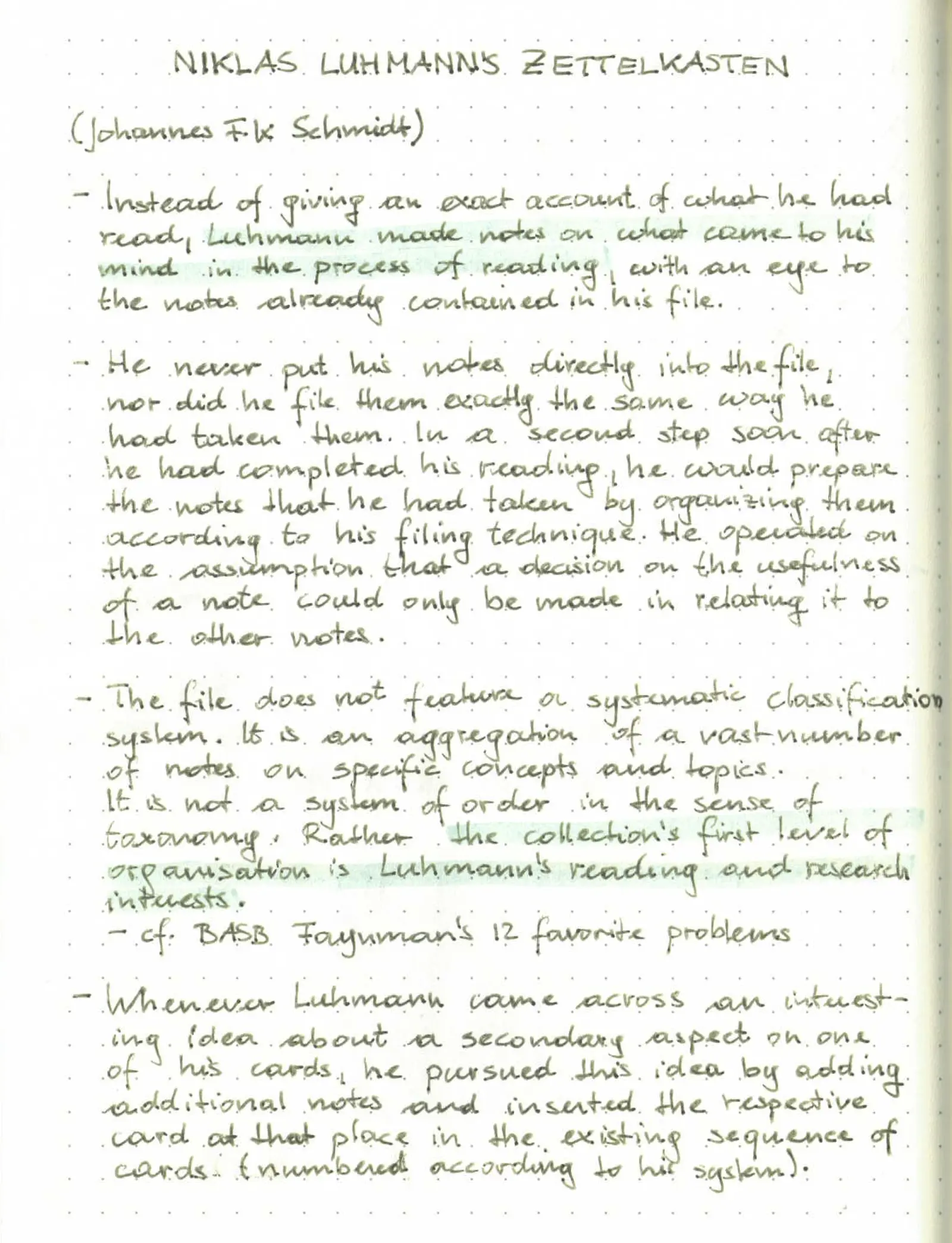
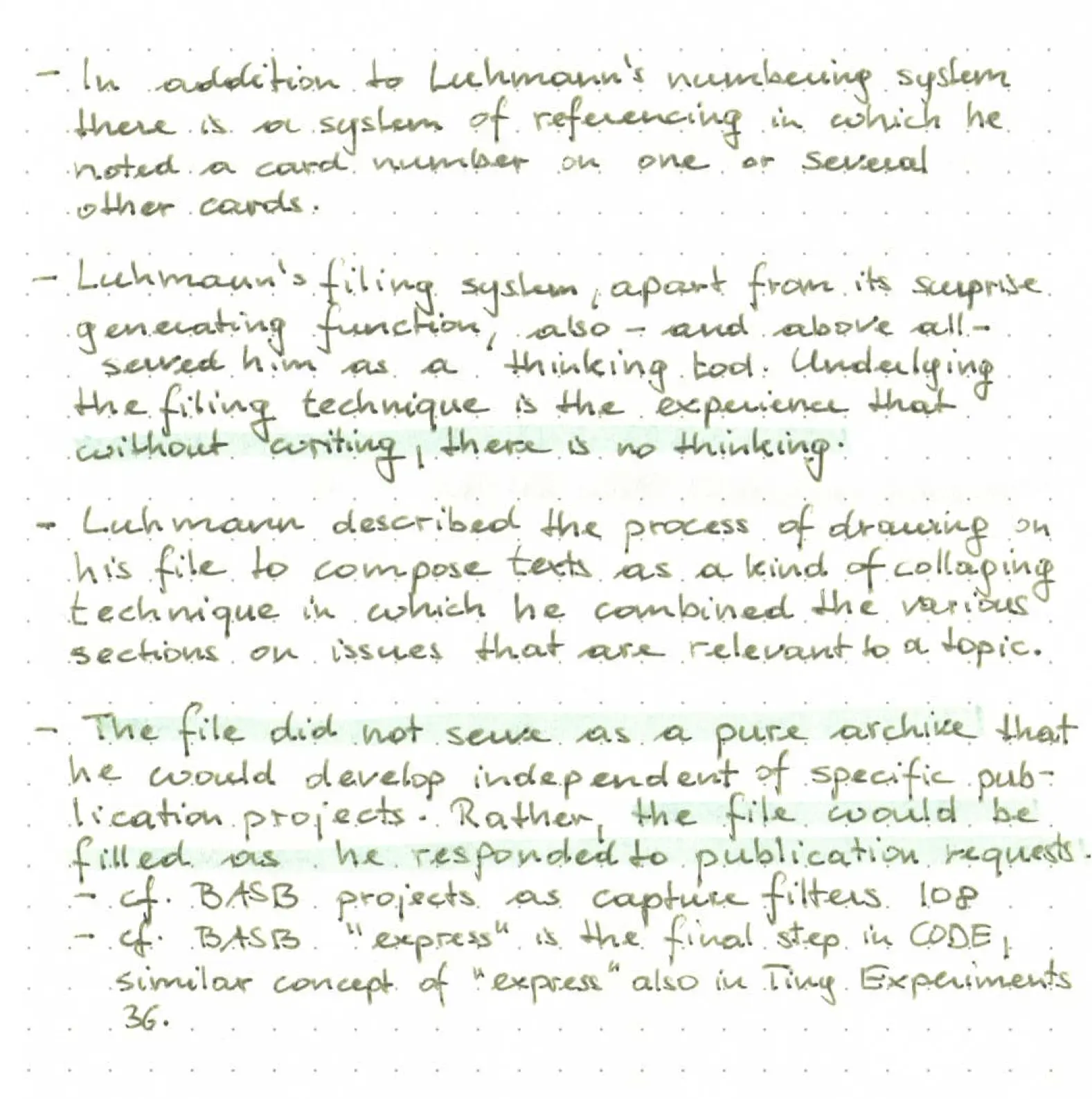
Typed version
**NIKLAS LUHMANN'S ZETTELKASTEN**
(Johannes F.K. Schmidt)
* Instead of giving an exact account of what he had read, Luhmann made notes on what came to his mind in the process of reading, with an eye to the notes already contained in his file.
* He never put his notes directly into the file, nor did he file them exactly the same way he had taken them. In a second step soon after he had completed his reading, he would prepare the notes that he had taken by organizing them according to his filing technique. He operated on the assumption that a decision on the usefulness of a note could only be made in relating it to the other notes.
* The file does not feature a systematic classification system. It is an aggregation of a vast number of notes on specific concepts and topics. It is not a system of order in the sense of taxonomy. Rather the collection's first level of organisation is Luhmann's reading and research interests.
* cf. BASB Feynman's 12 favorite problems
* Whenever Luhmann came across an interesting idea about a secondary aspect on one of his cards, he pursued this idea by adding additional notes and inserted the respective card at that place in the existing sequence of cards (numbered according to his system).
* In addition to Luhmann's numbering system, there is a system of referencing in which he noted a card number on one or several other cards.
* Luhmann's filing system, apart from its surprise-generating function, also – and above all – served him as a thinking tool. Underlying the filing technique is the experience that without writing, there is no thinking.
* Luhmann described the process of drawing on his file to compose texts as a kind of collapsing technique in which he combined the various sections on issues that are relevant to a topic.
* The file did not serve as a pure archive that he would develop independent of specific publication projects. Rather, the file would be filled as he responded to publication requests.
* cf. BASB projects as capture filters 108
* cf. BASB "express" is the final step in CODE, similar concept of "express" also in Tiny Experiments 36.
Handwritten comments
Reply on paper
Write your comment by hand, attach one photo or single-page PDF, and email it to 2mu7@handwritten.blog. First-time senders confirm their email, and the author reviews every comment before it appears.